
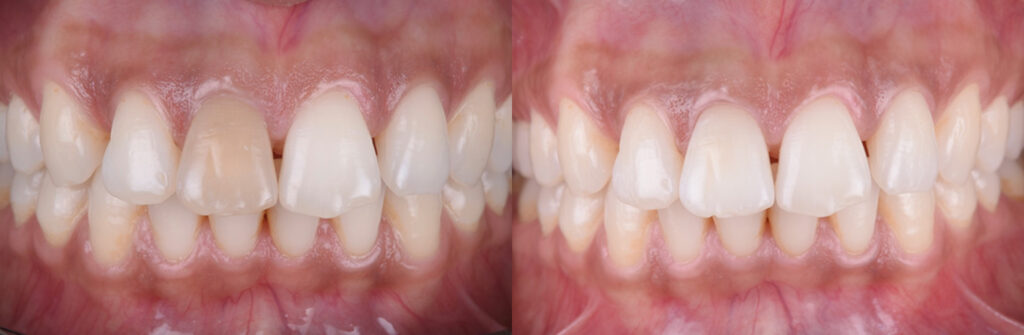
internal whitening (or internal bleaching) is the treatment of choice for a grey tooth or a tooth that has darkened after an injury. At the ORALYS dental practice in Tunis, we use this conservative technique to restore a natural shade to the tooth, without drilling it down and without a crown.
Why does a tooth turn grey after an injury?
After a knock, bleeding can occur inside the tooth (pulp haemorrhage). Blood pigments gradually spread into the dentine, giving the tooth a grey, brown or blackish appearance. The nerve of the tooth may also die, which makes the discolouration worse.
Other causes can darken a tooth from the inside:
- a a root-treated tooth that darkens over the years;
- residues of filling materials in the pulp chamber;
- nerve death that went unnoticed.
What is internal whitening?
Unlike conventional teeth whitening, which works on the surface of the teeth, internal whitening works from inside the tooth, where the discolouration is. That is why it is much more effective on a root-treated or injured tooth than external whitening.
How is internal whitening carried out at ORALYS?
- Assessment and X-ray: we check the condition of the nerve, the root and the bone around the tooth.
- Root canal treatment if needed: if the tooth has not yet been root-treated or the previous treatment is inadequate, a Endodontic treatment is carried out first.
- Protecting the root: a sealing plug is placed above the canal filling to isolate the root from the product.
- Placing the whitening product: the product is placed inside the tooth, then the cavity is temporarily closed. It works for a few days.
- Check and repeat: the procedure is repeated if needed until the shade is close to that of the neighbouring teeth.
- Final restoration: the tooth is permanently sealed with an aesthetic composite.
How long does treatment take?
In general, 1 to 3 sessions are enough. Treatment extends over a few days to a few weeks, depending on how the tooth responds and how strong the initial discolouration is.
The benefits of internal whitening
- Conservative: the natural tooth is kept, without drilling it down.
- Aesthetic: the tooth regains a shade that matches the rest of the smile.
- An alternative to prosthetics: in many cases, it avoids the need for a veneer or a crown.
- Well tolerated: since the tooth is root-treated, sensitivity is rare.
A safe, well-controlled treatment
Internal whitening is a safe treatment when it is properly indicated and carried out by a practitioner. Protecting the root and X-ray follow-up limit the risks. Over time, the tooth may darken slightly again; a single touch-up session is then often enough to recover the shade.
If the tooth is badly damaged or the discolouration persists, other aesthetic solutions can be offered, such as a veneer or a restoration using adhesive dentistry.
FAQ – Internal whitening
Can a tooth that is not root-treated be whitened from inside?
Internal whitening applies to root-treated teeth. If the nerve is still alive, other solutions are considered, such as external whitening.
Is the result permanent?
The result is long-lasting, but slight re-darkening may occur after several years. A touch-up is then possible.
Is the treatment painful?
No. Since the tooth is root-treated, the treatment is generally painless.
Should the tooth be treated quickly after a knock?
Yes, it is advisable to see a dentist after any dental injury, even without pain, to monitor the vitality of the tooth and act at the right time.
Do you have a grey tooth after a knock?
Every situation is different. Our team carries out a full assessment to determine whether internal whitening is right for your case, or whether another aesthetic approach would be better. Book an appointment via our contact page or on WhatsApp at +216 96 883 443.