
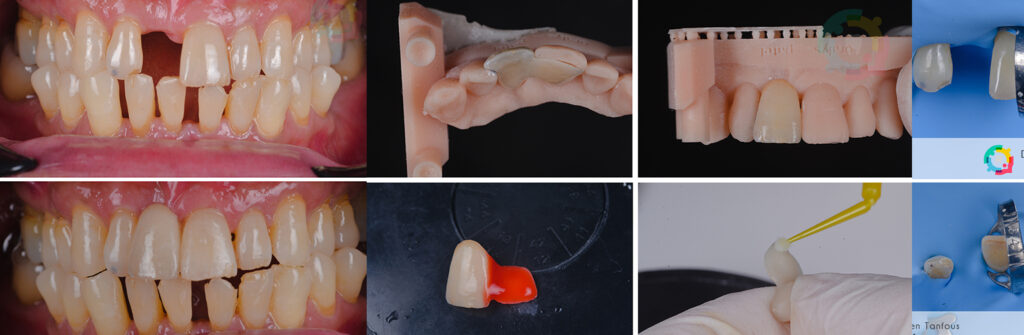
The bonded bridge, also called Maryland bridge, is an aesthetic and minimally invasive solution to replace a missing tooth (usually a front tooth). Unlike a conventional bridge, it does not require significant reduction of the neighbouring teeth, because it is held by ceramic wings bonded to the inner surfaces of the adjacent teeth.
This technique is ideal for front teeth, when the loss of a single tooth needs to be replaced quickly and aesthetically, while preserving the natural teeth as much as possible.
When is a bonded bridge suitable?
A bonded bridge is recommended when:
- A single tooth is missing, especially at the front (incisors or canines)
- The neighbouring teeth are healthy and intact
- The patient wants a fixed, discreet solution without significant reduction of the supporting teeth
- A quick, minimally invasive alternative to a dental implant is sought
⚠️ Limitations and drawbacks :
- Mainly suitable for front teeth, not for molars
- Less durable than a conventional bridge or an implant (usually 5 to 10 years)
- The metal wings may be slightly visible in some situations
- Requires careful maintenance and regular follow-up to prevent debonding
Steps for fitting a bonded bridge
- Consultation and assessment
- Clinical examination and X-rays to assess the neighbouring teeth and the gum
- Discussion of your aesthetic and functional expectations
- Minimal preparation of the supporting teeth
- The inner surfaces of the neighbouring teeth are lightly micro-roughened to ensure perfect adhesion
- No major reduction of the natural teeth is needed
- Impressions and fabrication
- Precise digital impressions to create a custom-made bridge
- Shade selection for a natural result
- Fitting and bonding
- The bridge is bonded to the supporting teeth with an ultra-strong adhesive resin
- Checking comfort, bite and appearance
- Check-up and follow-up
- Check-up appointment to ensure the stability and comfort of the bridge
- Advice for daily care
How long does it take to fit a bonded bridge?
- 2 appointments are enough
- Treatment is quick, with no heavy preparation of the neighbouring teeth
- Immediate adaptation for chewing and smiling
Lifespan and maintenance
A bonded bridge can last 5 to 10 years if the supporting teeth are well looked after.
To extend its lifespan:
- Brush your teeth 2 to 3 times a day
- Use dental floss or interdental brushes around the bridge
- Regular check-ups with your dentist
- Avoid biting hard objects that could loosen the bridge
Advantages of the bonded bridge
✔ A minimal, conservative solution
✔ Quickly restores your smile
✔ Fixed and discreet
✔ Keeps the neighbouring teeth intact
✔ A quick alternative to a dental implant
Limitations to be aware of
- Mainly recommended for the front of the mouth
- Shorter lifespan than conventional bridges
- Strict follow-up and maintenance required
- Adjustments possible if the bridge comes loose
Frequently asked questions
Is it painful?
No, fitting is painless and only requires minimal preparation of the teeth.
Can I eat normally?
Yes, from the day it is fitted, the bonded bridge allows normal chewing, although very hard foods should be avoided for the first few days.
How long does a bonded bridge last?
Usually 5 to 10 years, depending on hygiene and regular follow-up.