
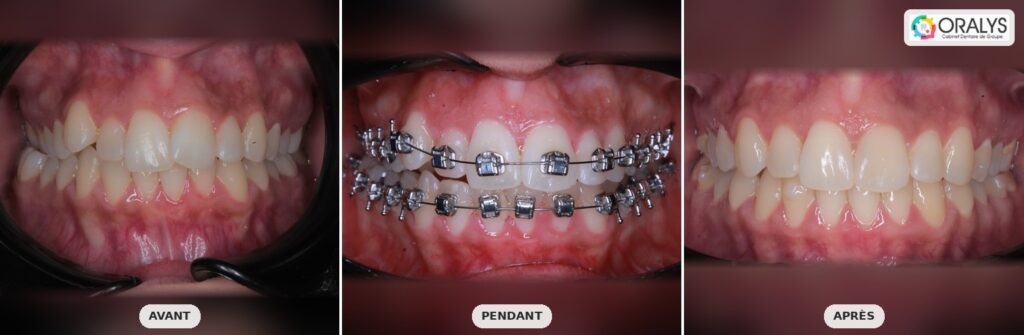
An orthodontic treatment in Tunis corrects the position of the teeth and jaws, for a more harmonious smile but also better function: chewing, breathing, hygiene and the long-term health of the teeth. At the Oralys dental practice, these treatments are carried out by Dr Anice Necibi, orthodontist, who offers several types of braces depending on each case: conventional braces, self-ligating brackets and the Pitts system.
Why have orthodontic treatment?
Orthodontics is not only about appearance. Misaligned teeth are harder to clean, wear unevenly and can cause tension in the jaw. The most common reasons for consultation are:
- crowded or overlapping teeth;
- gaps between the teeth (diastemas);
- protruding teeth or a receding jaw (Class II);
- lower jaw too far forward (Class III);
- deep bite (excessive overlap) or open bite (the front teeth do not meet);
- crossbite;
- preparation for prosthetic or implant treatment.
Orthodontics for children, teenagers and adults
In children, a first consultation around the age of 7 allows jaw growth problems to be detected early and treated at the right time.
In teenagers, ongoing growth makes many corrections easier: this is the most common age for wearing braces.
In adults, it is never too late. Adult braces can straighten teeth at any age, provided the gums and bone are healthy. At Oralys, Dr Anice Necibi can work together with the other practitioners (periodontist, prosthodontist, endodontist) when the case requires it.
The types of braces offered at Oralys
1. Conventional braces
Conventional braces are the reference technique in orthodontics. Small brackets are bonded to the teeth and connected by a metal wire held in place by ligatures (small elastics or fine wires). The wire is adjusted at check-up appointments to move the teeth gradually.
Advantages: a proven technique, effective for the vast majority of cases, including the most complex.
2. Self-ligating brackets
Self-ligating brackets have a built-in clip or small door that holds the wire, without elastics. The wire slides more freely in the bracket.
Advantages:
- no elastics trapping dental plaque: easier hygiene;
- less friction and lighter forces;
- comfort often appreciated by patients;
- adjustment appointments are sometimes quicker.
3. The Pitts system
The Pitts system (Pitts21) is a self-ligating technique developed by Dr Tom Pitts. It relies on a precise design of brackets and wires, combined with a specific treatment protocol.
Its strengths:
- gentle, progressive forces;
- particular attention to arch width and smile aesthetics;
- precise control of tooth movement for a functional and aesthetic result.
The choice between these techniques is made after the assessment, based on your case, your goals and your lifestyle.
How does orthodontic treatment work?
- First consultation: clinical examination, discussion of your expectations and first explanations.
- Orthodontic assessment: X-rays (panoramic, cephalometric), photos and impressions or an intraoral scan.
- Treatment plan: Dr Anice Necibi presents the recommended technique, the estimated duration and the quote.
- Fitting the braces: a painless session, with no anaesthesia.
- Follow-up appointments: usually every 4 to 8 weeks to adjust the appliance.
- Removal and retention: once the teeth are in place, a retainer (a wire bonded behind the teeth and/or a clear tray) stabilises the result.
How long does orthodontic treatment take?
The duration depends on the complexity of the case, age and regular follow-up. It most often ranges from 12 to 24 months, sometimes less for simple corrections and more for complex cases. A personalised estimate is given during the assessment.
Tips during treatment
- Brush your teeth after every meal, with a suitable toothbrush and interdental brushes.
- Avoid hard or sticky foods (toffees, chewing gum, hard nuts).
- Attend your check-up appointments.
- Wear your retainer as instructed to prevent relapse.
Why choose Oralys for your orthodontic treatment in Tunis?
- An orthodontist in Tunis dedicated: Dr Anice Necibi.
- Several techniques available: conventional, self-ligating, Pitts system.
- A multidisciplinary approach within a group practice.
- Personalised follow-up from the assessment to retention.
FAQ – Orthodontic treatment
Do braces hurt?
Fitting is painless. Slight discomfort may appear during the first days and after some adjustments, then quickly disappears.
Can adults wear braces?
Yes, adult orthodontics is very common, as long as the teeth and gums are healthy.
What is the difference between conventional and self-ligating braces?
Conventional braces use ligatures to hold the wire; self-ligating braces have a built-in clip, which makes hygiene easier and reduces friction.
Is the result permanent?
Teeth tend to move throughout life. Wearing a retainer is essential to keep the result.
Book an appointment
Would you like to straighten your teeth or your child's? Book an appointment with Dr Anice Necibi for an orthodontic assessment at the Oralys dental practice in Tunis, by phone on +216 96 883 443 or on WhatsApp.