
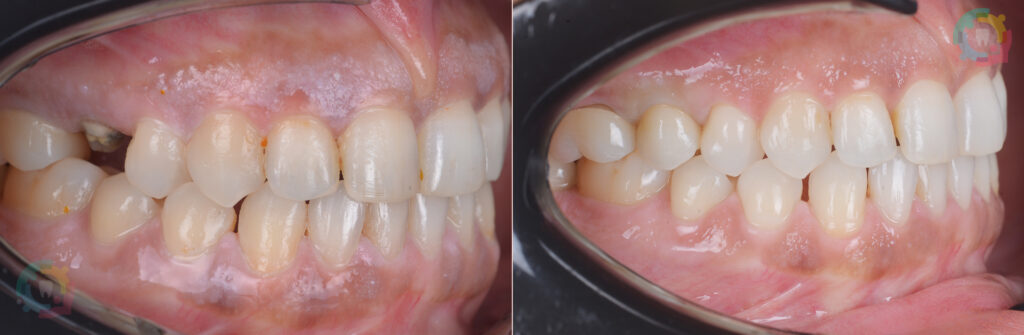
At Oralys, a group dental practice in Lac 2, Tunis, we know that every smile is unique. Losing a tooth can affect your appearance, but also your self-confidence and your oral health. Today,dental implant is the most modern, durable and aesthetic solution to replace one or more missing teeth, without touching the neighbouring teeth.
In this article, we explain what an implant is, when it is indicated, how placement works step by step at Oralys, and we answer our patients' most frequently asked questions.
What is a dental implant?
A dental implant is an artificial titanium root, inserted directly into the jawbone to replace the root of a missing tooth. Once in place, the implant gradually integrates with the bone through a natural process called osseointegration — a biological phenomenon comparable to the bone healing seen after a plate is fitted for a fracture.
Once integrated, the implant serves as a solid support for:
- a a crown (replacing a single tooth);
- a an implant-supported bridge (replacing several teeth);
- a a fixed or stabilised full prosthesis (replacing all the teeth of one arch).
Why choose a dental implant?
- Natural appearance — the implant reproduces the look and function of a natural tooth.
- Comfort and stability — unlike removable dentures, the implant is fixed: you eat, speak and smile without discomfort.
- Bone preservation — it stimulates the jawbone and limits the bone loss that follows the loss of a tooth.
- Preserving neighbouring teeth — unlike a conventional bridge, it does not require the adjacent teeth to be prepared.
- Longevity — with good hygiene and regular follow-up, an implant can last for decades.
When should a dental implant be placed?
- Replacing a single missing tooth, at the front or back of the mouth.
- Supporting a bridge when several teeth are missing.
- Replacing all the teeth of one jaw using the techniques All-on-4 and All-on-6.
- Stabilising a denture that moves, for better hold and comfort.
- An alternative for patients who do not tolerate removable dentures.
For a missing front tooth in a young patient, or when an implant is not immediately possible, a bonded bridge can also be an interesting alternative. Your dentist will present all the options suited to your case.
Immediate implant placement and immediate aesthetics
Immediate implant placement means placing the implant right after the tooth is extracted. It reduces the number of procedures and best preserves the bone volume and the shape of the gum.
Immediate aesthetics allows a temporary crown to be fixed as soon as the implant is placed, especially when one or more front teeth are involved.
The benefits of this approach:
- shorter overall treatment time;
- optimal preservation of bone and gum;
- a smile restored immediately, with no visible gap.
This technique is not possible in every situation: it depends in particular on bone quality and the absence of infection. It is assessed during the consultation.
All-on-4 and All-on-6: a full set of fixed teeth on implants
When all the teeth of a jaw are missing or cannot be saved, a full bridge can be fixed on just 4 or 6 implants. This technique avoids a removable denture and often makes it possible to have fixed teeth again shortly after surgery. It is particularly suitable for patients whose denture moves or whose teeth are badly damaged. Learn more about All-on-4 and All-on-6 →
Steps for placing a dental implant at Oralys
- Initial consultation — a complete assessment of your oral health, with a 3D X-ray (cone beam) and a digital impression to analyse the quality and volume of available bone.
- Personalised planning — a tailor-made treatment plan and the design of a surgical guide that allows the implant to be positioned precisely, according to the future crown. This step is carried out by our specialists, Dr Safa Ben Tanfous, periodontist, and Dr Malek Ghorbel, prosthodontist.
- Implant placement — a procedure under local anaesthesia, guided by the surgical guide, followed by a healing period of 2 to 3 months needed for osseointegration.
- Fitting the prosthesis — once the implant is fully integrated, the final crown (or bridge) is fixed for a functional and aesthetic result.
- Follow-up and maintenance — regular check-ups and scaling ensure the implant lasts.
What if I don't have enough bone?
After a tooth is lost, the jawbone gradually shrinks. When there is not enough bone to hold an implant, a bone graft or a sinus lift (for upper back teeth) can be carried out beforehand or at the same time as placement. The 3D X-ray taken during the consultation shows precisely whether this is necessary.
This is also why it is better not to wait too long before replacing a lost tooth.
Advantages and limitations of dental implants
Advantages:
- a durable, reliable solution;
- comfort and stability superior to removable dentures;
- a natural, personalised aesthetic result;
- protection against bone loss;
- no damage to neighbouring teeth.
Limitations:
- a higher initial investment than a removable denture;
- a surgical procedure and healing time;
- sometimes a prior bone graft if bone volume is insufficient;
- some situations require precautions: heavy smoking, poorly controlled diabetes, untreated gum disease.
How should you care for your implant?
An implant cannot get a cavity, but the gum around it can become inflamed if hygiene is inadequate (this is called peri-implantitis). To keep your implant as long as possible:
- brush your teeth twice a day with a soft toothbrush;
- use interdental brushes or dental floss around the implant;
- avoid or cut down on smoking;
- come for a check-up at least once a year.
Frequently asked questions about dental implants
Is placing a dental implant painful?
No, the procedure is done under local anaesthesia: you feel no pain during placement. Some discomfort or slight swelling may appear in the following days; it is well relieved by the medication prescribed by your dentist.
How long does implant treatment take?
Generally allow 3 to 6 months between placing the implant and fitting the final crown, for osseointegration. This can take longer if a bone graft is needed, or less with immediate implant placement and immediate aesthetics.
How much does a dental implant cost in Tunis?
The price depends on the number of implants, the type of prosthesis (crown, bridge, full prosthesis) and any additional procedures such as a bone graft. A detailed quote is given to you after the consultation and the 3D X-ray.
How long does a dental implant last?
With good hygiene and regular follow-up, a dental implant can last for decades. The crown on the implant may need to be replaced after many years of wear.
Can an implant be placed at any age?
An implant can be placed once jaw growth is complete, usually around the age of 18. There is no upper age limit: what matters is general health and bone quality.
Implant or bridge: which should you choose?
An implant has the advantage of not touching the neighbouring teeth and preserving the bone. A bridge may be indicated if the neighbouring teeth are already damaged or if an implant is not possible. Your dentist will help you choose according to your situation.
Do you live abroad? Find out how to organise your treatment at Oralys: remote assessment, preliminary quote and stay plan →
Book an implant assessment
Every clinical situation is unique. During your consultation at Oralys, our team studies your case with a 3D X-ray and offers you the most suitable solution, with a clear treatment plan and quote.
Oralys practice — Duplex 1, Résidence Farah Lake, rue de la Feuille d’Érable, Lac 2, 1053 Tunis.
📞 +216 96 883 443 · Book an appointment on WhatsApp